By VANGELIS ARAGIANNIS, Jazz & Tzaz, Greece | Issue #204, March 2010
[Jazz&Tzaz – View PDF]
Daughter of famous Bollywood composer Enoch Daniels, pianist Ramona Borthwick took her first musical steps in Bombay and there, along with husband, guitarist Noel Borthwick, recorded “Sound Matters” precisely 20 years ago, one of the first recordings of contemporary jazz in India. She later moved to Boston, where parallel to music, she got involved with graphic and web design.
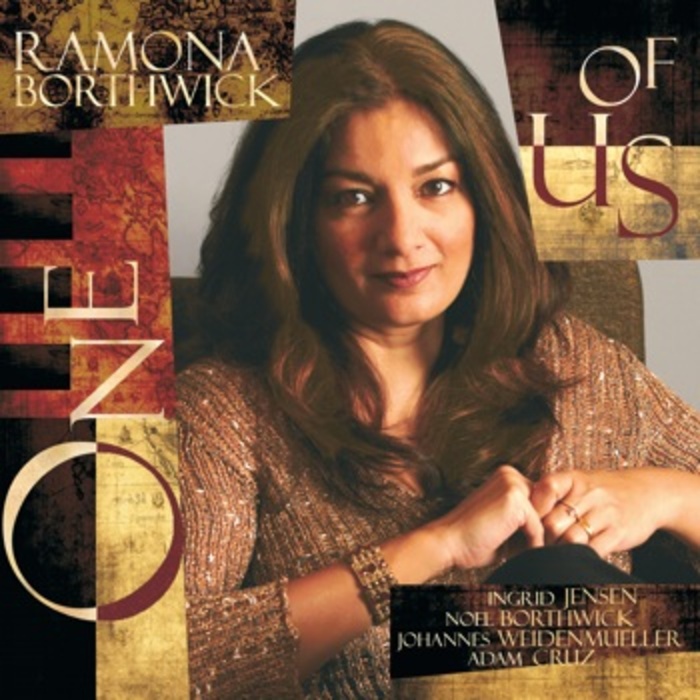
“One Of Us” is her second album and continues to be based on the same artistic blend of swing and lyricism which was present in her debut album in 2006 (“A New Leaf”). Ramona has the ability to match difficult rhythms and melodies, and builds a complex mosaic of components found in modern jazz, European music, sometimes in the Indian tradition and often in Latin, especially when accompanied by the piano with flexible vocal phonetics. The rare gift of being an equally good pianist, singer and songwriter, makes a difference to a degree that can hardly go unnoticed.
Aesthetically there seem to be no boundaries, and she has no problem transitioning from an acoustic environment (the romantic “One Of Us”) to an electric Fender Rhodes (as in the modal “Resident Alien”), or in the introduction of the Eastern “Gaia” and the constant changes of “Chinese Whispers”,
with the cheerful Latin “Rio Alegre” closing the album. All the musicians have played brilliantly, the band comprising Noel Borthwick on guitar, Ingrid Jensen on trumpet and flugelhorm, Johannes Weidenmueller on bass and Adam Cruz on drums.

 A few days later, we were enjoying an exquisite Indian buffet spread at a restaurant in another 5-star hotel a few kilometres away at an area popularly know as the Juhu beach. There was an outdoor wedding reception taking place on the beachfront. We saw headlines flash by on the restaurants big screen TV – there had been shootings at the main railway station in Mumbai, then at the Metro cinema in South Bombay. Within minutes, the channel was showing raw footage of the aftermath of gun attacks at Leopold’s Cafe. We thought it might be gang-related, but Leopold’s was hardly the kind of venue for assassinations of this sort. It was essentially a tourist hangout, and its clients didn’t didn’t seem to be sort who might be involved in trouble of this nature. Within few minutes we heard that the Taj was under attack,
 It is late afternoon, and I’m writing this article on a muggy, fall day in New York City’s Central Park. I’m seated on patchy grass after finding myself a hotspot (thanks to free wi-fi in the park), catching up on e-mail and news. I arrived here on the comfortable Acela train from Boston, three and a half hours of super-smooth travel that skirted the Eastern seaboard with barely a whisper. Since my arrival, I’ve been drawn into a gritty, urban state of mind, while savouring the ability to keep walking for hours, being simultaneously assaulted and lulled by the sights and sounds of Manhattan. In contrast, the park is an anticlimax – a green cocoon of quiet; free of exhaust and the taut energy that wraps the avenues outside. The purpose of my visit? None really. I have no appointments to keep, no deadlines to meet. I’m staying at the New Yorker Hotel, in midtown Manhattan. Built in the art deco style of the jazz swing era, it was one of NYC’s premier hotels and hosted famous big bands such as those led by Benny Goodman and Woody Herman during its heyday. Unfortunately it stands in various states of disrepair today, but its location is hard to beat, offering an almost instant access to several key tourist spots and vistas in the city core. Situated a few blocks north is Times Square and Central Park, and to the South, Lower Manhattan and the Village with its interesting, funky neighbourhoods such as SoHo, Chelsea, Little Italy and Chinatown.
  [This article was published in the August 2007 issue of the Qatar-based feature magazine ‘New Era’.]